Privet Berry Dye Experiments

In early January, I noticed an abundance of beautiful berries on the wild Privet along the creek. Remembering some interesting results another natural dyer had achieved on wool, I decided to give it a try on 100% Linen. While berry dye is most often fugitive, and not suitable for items that will be frequently washed, they can still be fun to work with.

I try to keep a supply of prepared fabric on hand for such random notions. The fabric and thread for this experiment was previously scoured, pretreated with a tannin, and a mordant appropriate for cellulose fibers. So, the fun can begin immediately.

The Process
After collecting berries, I weighed them and cut a piece of linen fabric that was 1/3 the weight of the berries to yield a 3:1 ratio of fresh berries to fabric (300% Weight of Fiber). I further cut it into 4 smaller pieces so I could experiment with pH adjustments. The linen and 4 prepared samples of 100% cotton thread were placed in hot tap water to wet out.
Meanwhile, the berries were covered with water in a large stainless steel dye pot and simmered for about 20 minutes, then squeezed, strained, covered with more water and heated for another hour. I was careful not to boil the berries, concerned that this could affect the color.
Squishing the berries was undoubtedly the best part of this process.

After the second strain, I combined the dye water and added all the pre-wetted fabric & thread. The dye water was rich and the berry mash was exhausted of color.
The dye bath was heated, with regular temperature checks to keep it around 175 -180
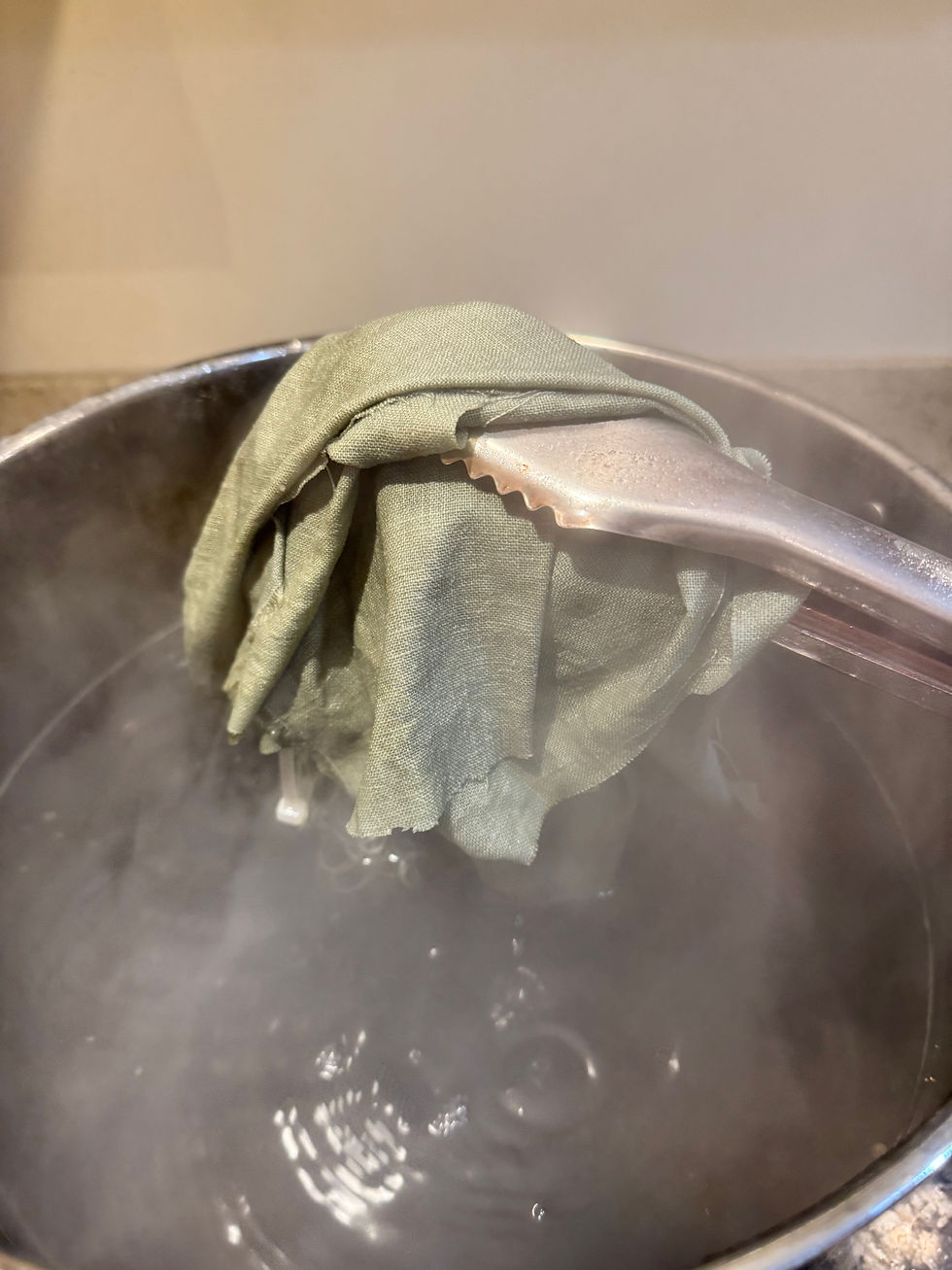
degrees. Linen can be heated to higher temps than wool, but I didn’t want to overheat the dye and cause it to turn brown. A 20 minute check on the fabric revealed a beautiful shade of blue-green. Always on a quest for shades of green, this was exciting! I continued the dye bath for a total of 1 hour, then removed and gently rinsed the fabric. For some natural dyes, it is beneficial to leave the fabric to sit in the dye bath overnight, but for this experiment I suspected the color would dull and did not. That can be a variable to experiment with another time.
pH Adjustments
In order to test the effects of pH on the final results, I separated the four pieces of dyed linen and thread. One of each was set aside to leave as is. The pH of the dye bath was right at 7, so this was our unaltered neutral sample. I prepared 1 bucket of vinegar water at a pH of 4 and a second bucket of water with Soda Ash added at a pH of 10. 1 each of the dyed fabric samples and thread was placed in each bucket and stirred for 1 minute. Last, I added soda ash directly to the warm dye bath and returned the fourth set of samples for 1 minute. Each piece was rinsed, labeled, and hung to dry.
The Results
Independent of poor lighting for photography, the final results were surprising. The unaltered sample was by far my favorite, retaining that beautiful blue-green shade. The samples from both Soda Ash experiments (pH of 10) yielded shades of khaki-ish green. The sample that was placed in the vinegar solution (pH of 4) was significantly lighter than the unaltered sample, as is some of the color was stripped out, but the silvery green was still lovely.
Notes
In natural dying, there are many elements that can affect results. Intentionally modifying variables are how we can use a single dye source to achieve different shades. Some are sensitive to pH, as shown in this experiment. Time in the dye bath, temperature of the dye bath, water quality, etc. are all factors that can affect the results. When wildcrafting dye materials, another factor to consider is the time of year and conditions. These berries were collected in January and were ripe. While our Western Kentucky winters are usually fairly mild, we had experienced frost and freeze at this point. Testing with unripe berries could yield even more variations in color. The possibilities are endless!
Stay tuned for Part 2 as I continued to experiment with these samples even further, and look at how well the color holds up.


Comments